A Quiet Seasonal Reset for the Household Linen Shelf
A seasonal reset for the household linen shelf helps you sort by current use, flag items needing care, and put everyday cloth within easy reach.
A seasonal reset for the household linen shelf works best when it follows the weather and your household’s routines, not an idealized inventory. Pull forward what you are using now, set aside cloth that needs attention, and return the rest in an order that makes the next change easy.
The job need not mean emptying every cupboard or deciding the fate of every old towel. Choose one shelf or drawer, then compare three useful approaches: a quick rotation, a more deliberate condition sort, or a small-space arrangement that makes double duty manageable.
Which seasonal reset suits your household?
A quick rotation is for a shelf that is already in decent shape. Move current-season items to the front, shift less-used pieces behind them, and take out anything visibly damp, musty, stained, or torn. It is a light adjustment, not a full audit.
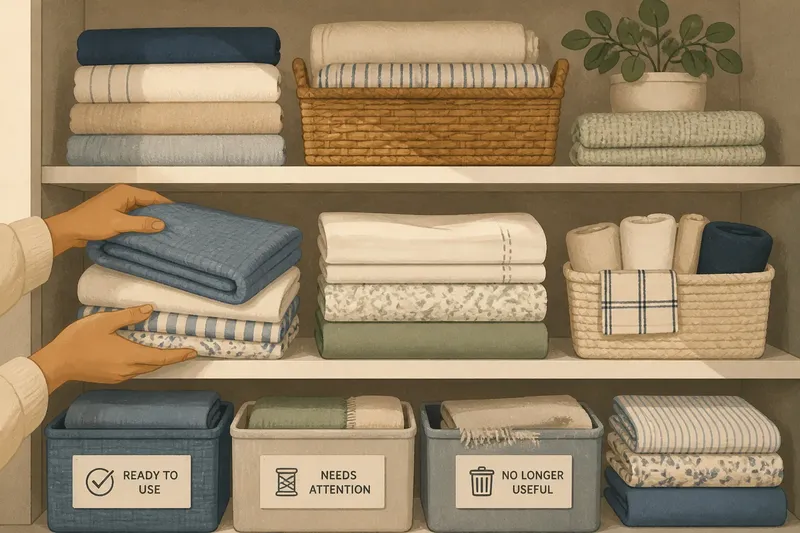
A condition sort suits a shelf with a few lingering questions: towels that never feel quite dry, sheets with a weakened corner, or tablecloths saved for a possible occasion. Make three temporary groups—ready to use, needs attention, and no longer useful in its present role. The middle group is a prompt for a specific next action, not a new permanent pile.
A space-first reset is useful when the shelf is crowded or shared by more than one room. Keep the most frequently used linens together at the front, and give occasional or specialty pieces a clearly bounded place. If the shelf serves a guest room, kitchen, and bathroom, small labeled baskets can keep unlike tasks from collapsing into one stack.
Choose the lightest approach that addresses the problem you can actually see. If the shelf functions well, a rotation is enough; if items need decisions, sort condition; if access is the trouble, arrange by use.
What belongs at the front of the shelf?
Start with the next season’s ordinary demands. Warm weather may bring more frequent use of lightweight bath towels, picnic cloths, or cotton napkins. Cooler months may put flannel sheets, extra blankets, or heavier bath linens into regular service. Keep the current rotation within easy reach, but avoid burying the alternate set so deeply that changing it becomes a chore.
Sort by task before color or matching appearance. A stack of hand towels near the bathroom linens is easier to use than a visually coordinated stack scattered across several shelves. Pillowcases can sit with the sheets they fit; kitchen cloths belong with kitchen use rather than beside guest bedding simply because the colors match.
Imagine a household that has kept lightweight sheets at the back through the warm months. As evenings turn cooler, the household brings the warmer set forward, checks its corners for loose seams, and places the lighter set behind it. The expected visible result is a shelf that offers the needed bedding first, with the alternate set still easy to retrieve.
Give frequently used items a little breathing room. A stack that leans into the next pile makes it harder to take one towel without disturbing the rest. Fold to a size that fits the shelf depth, not to an elaborate display standard.
How should you handle linens that need attention?
Set aside only items with a clear next action. A washable stain may call for laundering; a loose hem may merit mending; a musty smell may mean the item needs to be aired and checked before it returns to storage. Keep this group separate from clean, ready-to-use linen so that the decision does not vanish into the stack.
For an item that is no longer comfortable or useful in its original role, consider whether it can serve another household task. A worn bath towel might be kept for cleaning, while a faded tablecloth may still work under craft materials. Retain it only if the secondary use is real and there is a sensible place to keep it. Otherwise, set it aside for an appropriate textile collection or disposal option available locally.
Do not keep a “maybe” pile without a boundary. Put uncertain items in one small container or on a designated shelf, and make the next decision when you handle them again. For laundering, stain care, and storage, follow the fabric label and product instructions where they apply.
Should you rotate, sort by task, or group by room?
These systems solve different problems, so they do not need to compete. Rotation answers, “What will I reach for now?” Sorting by task answers, “What belongs together?” Grouping by room answers, “Where will I use it?” A shelf may use all three, as long as each choice has a clear purpose.
Keep a simple arrangement if several people use the shelf: everyday bath towels on one side, bedding together, and occasional table linens on a higher or less accessible shelf. If one person handles most laundry and linen changes, grouping by room may make more sense because it gathers each room’s supplies in one place. Avoid a system that requires everyone to remember a complicated folding code.
Choose a location by how often you reach for an item. The everyday stack belongs at a comfortable height; spare or seasonal pieces can take the less convenient spot. A shallow basket can contain small items such as pillow protectors or cloth napkins, while labels help only when the contents are not obvious.
What questions help you finish the reset?
How often should I reset a linen shelf?
Use a seasonal change as a natural prompt, but adjust the timing to your routines. If a shelf becomes difficult to use sooner, a small rotation is more sensible than waiting for a particular date.
Do household linens need to match?
No; fit, condition, and purpose matter more to daily use than a coordinated appearance. Keep compatible sizes together where that helps, but a mixed stack can be easier to maintain than a set that leaves you short on usable pieces.
What should I do with linens I rarely use?
Keep occasional pieces if they have a real purpose and a defined storage place. If you cannot name when or how they are used, set them aside for a separate decision rather than letting them occupy the everyday shelf.
How can I keep the shelf from becoming crowded again?
Return clean items to their assigned groups and avoid adding a new stack without deciding where it belongs. When the shelf feels full, remove the least-used item before compressing every pile more tightly.
How do you know the shelf is ready?
Close the cupboard or step back from the shelf and check whether the first item you need is obvious. You should be able to lift a towel or sheet without pulling down a neighboring stack, and anything awaiting care should be visibly separate from clean linen.
For a quiet seasonal reset, that is enough. Keep the arrangement that makes current use easiest, and let the next season supply the next small adjustment.